
If you have spent any time researching mushroom supplements, you have likely encountered two terms: “fruiting body” and “mycelium.” These are not just technical details. They describe fundamentally different parts of the mushroom, and the difference has real implications for what ends up in your capsule.
What is the fruiting body?
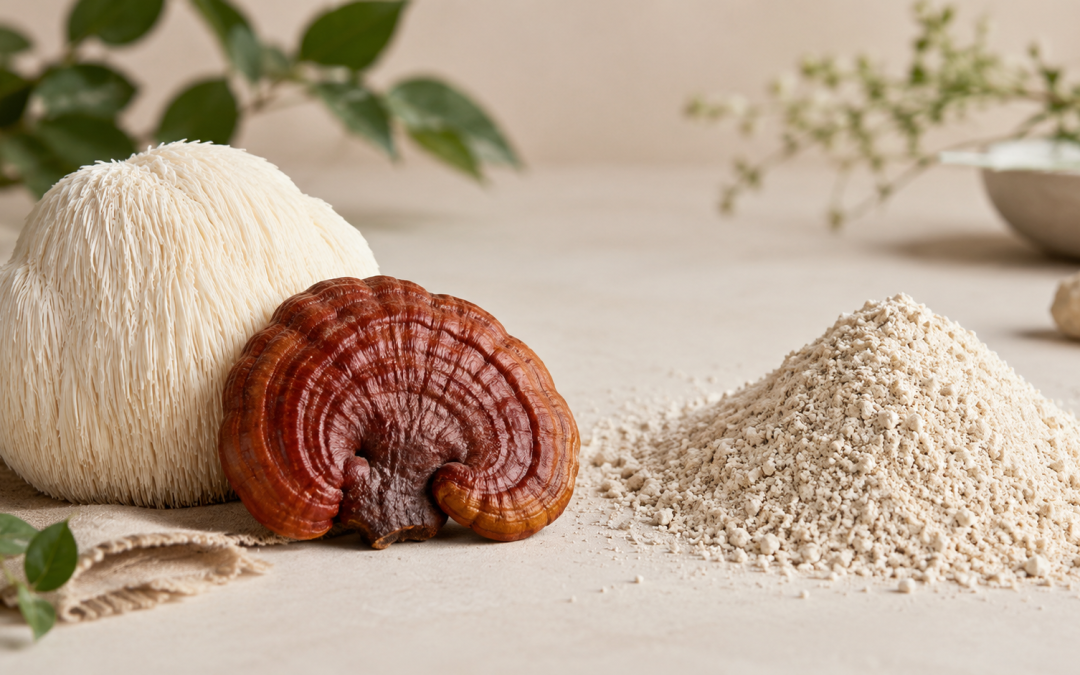
The fruiting body is the visible part of the mushroom. It is what you would recognize if you saw one growing: the cap, the stem, and the distinct structure most people picture when they think of a mushroom. In functional species like Reishi, Lion’s Mane, and Cordyceps militaris, the fruiting body is where the primary active compounds concentrate.
For Reishi (Ganoderma lucidum), those compounds are triterpenes (specifically ganoderic acids) and beta-glucans. For Lion’s Mane (Hericium erinaceus), researchers focus on hericenones and erinacines, along with beta-glucans. For Cordyceps militaris, the key compounds include adenosine and cordycepin. In all three cases, fruiting body extracts consistently show higher concentrations of these compounds compared to mycelium-based alternatives.
What is mycelium?
Mycelium is the network of thread-like structures that a mushroom grows from. Think of it as the root system. Mycelium is not inherently inferior as a biological material, but the way it is produced for commercial supplements creates a quality problem.
Most commercially produced mycelium is grown on a grain substrate: typically rice, oats, or sorghum. After fermentation, the mycelium and the grain it grew on are dried and ground together. The result is a product that may contain 50 to 70 percent starch from the grain, with a corresponding reduction in active compound content. Labels sometimes describe this as “myceliated grain” or “full-spectrum mushroom,” but the practical effect is a lower concentration of beta-glucans per gram.
Why this matters for consumers
Beta-glucans are the primary bioactive compounds in medicinal mushrooms. They are polysaccharides found in the cell walls of the mushroom, and they are the compounds most consistently referenced in the research literature on functional fungi. A quality mushroom extract should specify a beta-glucan percentage on the label, typically somewhere in the 20 to 40 percent range depending on the species.
A product that lists only “total polysaccharides” rather than beta-glucans specifically may be overstating its active compound content. Starch from grain substrate is also a polysaccharide and can inflate total polysaccharide figures without adding any of the functional compounds researchers are actually studying.
If you are evaluating a mushroom supplement and the label does not specify beta-glucan content or does not identify whether the product is fruiting body or mycelium, that gap is worth noting.
The role of extraction method
Source is one piece of the picture. Extraction method is another. Raw mushroom powder contains active compounds, but they are largely locked inside the mushroom’s cell walls, which are made of chitin (the same structural material found in insect exoskeletons). The human digestive system cannot break down chitin efficiently, which means raw powder has limited bioavailability compared to a properly extracted product.
A hot water extraction breaks down the cell walls and makes beta-glucans accessible. An alcohol extraction captures fat-soluble compounds like the triterpenes in Reishi. A dual extraction combines both processes. For Reishi specifically, dual extraction is important because both compound classes are considered central to the product’s studied profile.
How Health Canada NPN licensing fits in
In Canada, a Natural Product Number (NPN) indicates that a supplement has been reviewed by Health Canada before it reaches the market. That review includes an assessment of ingredient quality, the evidence behind the label claims, and the manufacturing facility’s standards. It does not replace your own label reading, but it establishes a minimum threshold.
Not all mushroom supplement brands operating in Canada hold NPNs for their products. Checking for an NPN is a useful baseline step alongside the sourcing and standardization information discussed above.
What to look for
Four things are worth checking when evaluating a mushroom extract. First, whether the product comes from the fruiting body. Second, whether it lists a specific beta-glucan percentage rather than just total polysaccharides. Third, whether the extraction method is appropriate for the species (hot water for most; dual extraction for Reishi). Fourth, whether the product carries a Health Canada NPN if you are purchasing in Canada.
Brands that prioritize extract quality tend to list these details clearly. The absence of this information on a label is itself informative.