
By Genio, founder of Luminary Mushrooms and Health Canada NPN license holder
Lion’s Mane (Hericium erinaceus) gets more attention in the cognitive health conversation than almost any other functional mushroom. Most of that attention traces back to two compound groups unique to this species: hericenones and erinacines. Understanding what they actually do, and where the evidence is genuinely strong versus where it is still thin, takes more than what most supplement websites offer.
What hericenones and erinacines are
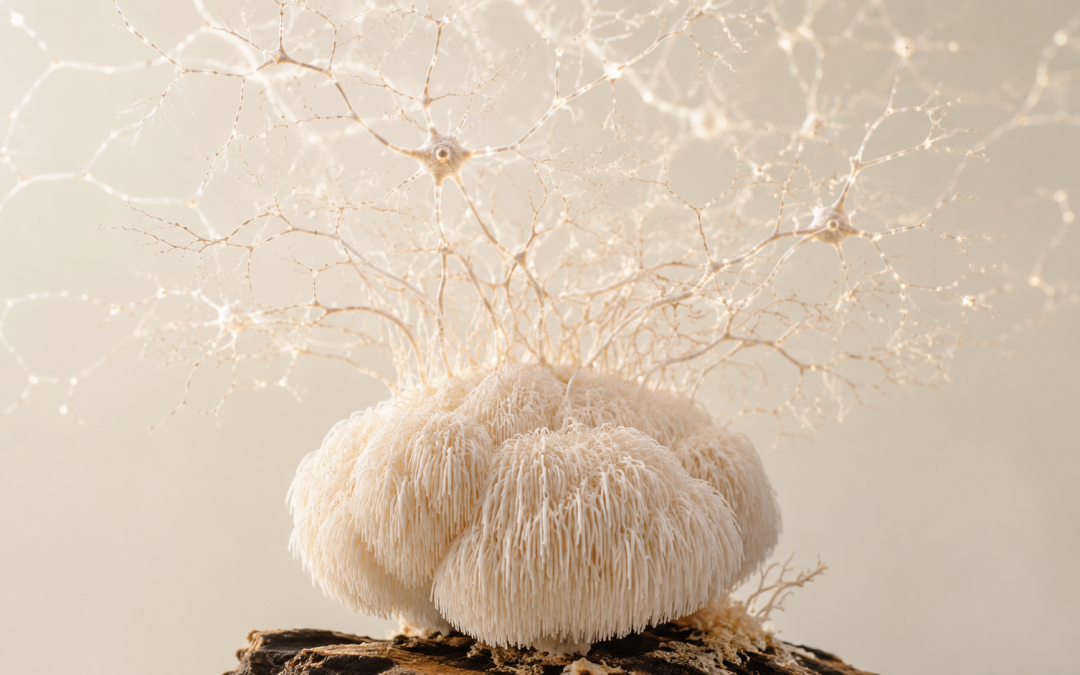
Hericenones are found in the fruiting body of Lion’s Mane. Erinacines are found in the mycelium, the root-like network the mushroom grows from. Both groups have been studied for their relationship to Nerve Growth Factor (NGF), a protein the brain produces to maintain and repair neurons. That connection is where most of the interest in Lion’s Mane originates.
The fruiting body versus mycelium distinction matters for supplementation. A fruiting body extract will contain hericenones. An extract derived from mycelium will contain erinacines. Some researchers consider erinacines to have a more direct NGF-stimulating effect, though comparing them is complicated because studies use different models, concentrations, and extraction methods. A label that does not specify which part of the mushroom was used leaves you guessing about which compounds you are actually getting.
What NGF does and why researchers care
Nerve Growth Factor was first identified in the 1950s, and the scientists who characterized it, Rita Levi-Montalcini and Stanley Cohen, received the Nobel Prize in Physiology or Medicine in 1986. NGF plays a role in the survival, growth, and maintenance of certain neurons, particularly in the peripheral and central nervous systems.
Compounds that stimulate the body’s own NGF production have been studied as a possible avenue for supporting neuronal health over time. That is the scientific basis for Lion’s Mane research. It is a plausible and well-reasoned area of study, which is different from saying the outcomes are proven in humans at scale.
Where the evidence is strong
In cell models and animal studies, both hericenones and erinacines have consistently shown the ability to stimulate NGF production. These findings are fairly well-replicated and provide a credible mechanistic foundation.
One of the most-cited human studies is a 2009 double-blind, placebo-controlled trial by Mori and colleagues, published in Phytotherapy Research. Older adults with mild cognitive impairment who took 3 grams per day of Hericium erinaceus powder for 16 weeks showed significant improvements on a cognitive assessment scale compared to the placebo group. This is a real result from a real trial, and it is often cited accurately.
Where the evidence is thin
Here is the honest part. Most of the NGF-related human research is limited in scale. Many studies are small (under 50 participants), short-term (under six months), or conducted without placebo controls. The 2009 Mori study also noted that improvements reversed after supplementation stopped, which raises questions about mechanism and duration that later research has not fully resolved.
There is also a meaningful gap between NGF stimulation in a cell culture and measurable cognitive change in a healthy adult. Most studies showing NGF activity are in vitro or in rodents. Translating those findings to human outcomes is not straightforward, and the field has not yet produced the large, long-term randomized controlled trials that would be definitive.
To state it plainly: the compound basis for Lion’s Mane and brain research is real and well-established. The clinical evidence in healthy adults is promising but still early.
What to look for in a Lion’s Mane supplement
Extraction ratio and source material matter. A fruiting body extract concentrated at a higher ratio will contain more hericenones per capsule than a raw powder or a mycelium-on-grain product. Look for a label that discloses the plant part used and the extraction ratio. If neither is listed, the manufacturer is not giving you the information needed to evaluate what you are buying.
Luminary’s Lion’s Mane extract is sourced from the fruiting body and holds an NPN 80126702 from Health Canada. The NPN licensing process requires documented ingredient standards and a quality review before a product can be sold in Canada, independently of anything stated on the label or website.
Our position on the evidence
We could write a simpler product page that says Lion’s Mane supports memory and focus. We have chosen not to, because the honest picture is more useful and because the NPN licensing framework holds us to accuracy in our claims. The science behind this mushroom is genuinely interesting. It does not need to be overstated to be worth paying attention to.
If you want to see the sourcing and extraction details for our Lion’s Mane, you can find them on the product page.