
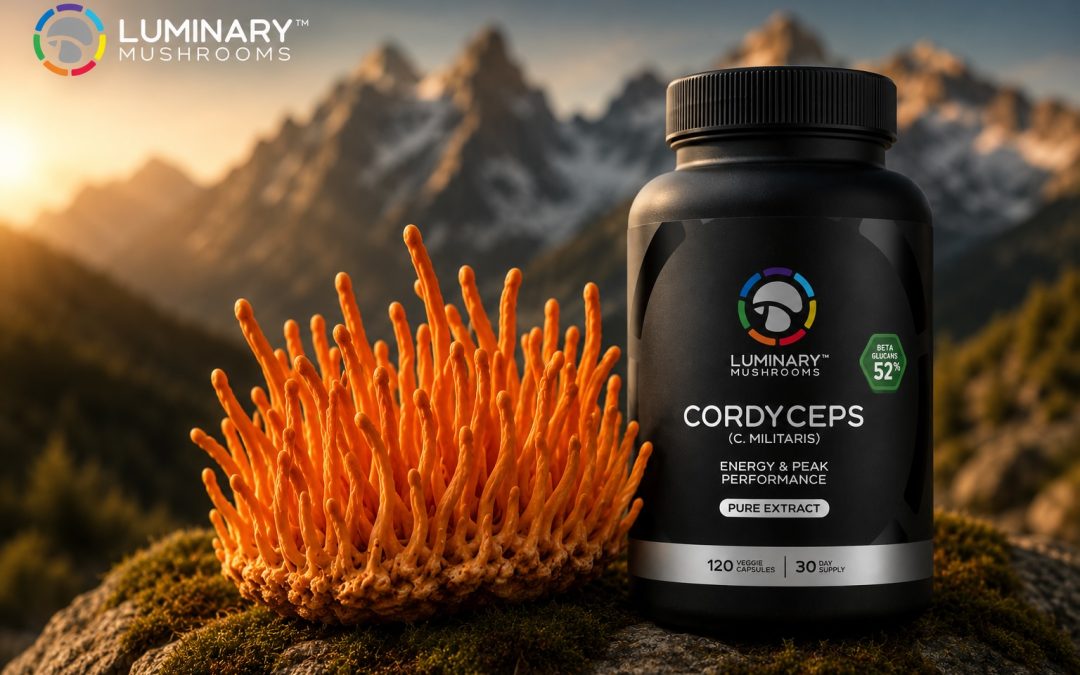
By Genio, founder of Luminary Mushrooms and Health Canada NPN license holder
Cordyceps has been used in Tibetan and Chinese traditional medicine for centuries, primarily as a tonic for physical stamina and endurance. Today it is one of the more widely sold functional mushroom supplements in North America, with claims ranging from improved athletic performance to enhanced mental focus. Most of that coverage skips a detail that matters: there are two main species, and they are not equivalent in composition, cost, or research profile.
Cordyceps militaris vs Cordyceps sinensis
Wild Cordyceps sinensis grows at high altitudes in the Himalayan plateau. It is a parasitic fungus that infects caterpillar larvae and has historically been harvested by hand from Tibetan grasslands. It is genuinely rare. Authentic wild Cordyceps sinensis sells for thousands of dollars per kilogram, which makes it impractical as a commercial supplement ingredient at any dose worth taking.
Nearly all commercial Cordyceps supplements use Cordyceps militaris instead. Militaris is a related species that can be cultivated in controlled growing environments. This makes it far more affordable and more consistent from batch to batch. It also contains substantially higher concentrations of cordycepin than wild sinensis does.
This distinction matters because most pages discussing “Cordyceps benefits” do not specify which species they are writing about. Research findings from militaris studies do not automatically apply to a sinensis product, and vice versa. If a supplement label does not name the species, that is information worth requesting before you buy.
Cordycepin and Oxygen Utilization
The compound most studied in Cordyceps militaris research is cordycepin, also known as 3′-deoxyadenosine. It is an adenosine analogue, meaning its molecular structure closely resembles adenosine, a compound that plays a central role in cellular energy transfer and ATP production.
The proposed mechanism is that cordycepin interacts with adenosine receptors and may support how cells manage oxygen availability and energy output. Multiple in vitro studies and animal model experiments have investigated this pathway. A smaller number of human trials have examined exercise performance, particularly VO2 max (the maximum rate of oxygen consumption during exertion), in older adult participants.
Where the Evidence Is Strong and Where It Is Thin
The research on Cordyceps and oxygen utilization is among the more credible areas of functional mushroom science. It has a mechanistically coherent explanation, a reasonable body of preclinical evidence, and some human trial support. That is a meaningful foundation.
The evidence for performance effects in healthy, trained athletes is thinner. Human studies that produced positive results were generally conducted with untrained older adults. Studies in younger, fit populations have returned mixed results. The strongest claims you will find in supplement marketing are ahead of what the current evidence actually supports.
The evidence for cognitive focus is even weaker. Cordyceps is often marketed for mental focus as an extension of its energy claims, but there is no strong, direct research base for cognitive performance in healthy adults. If a brand is leading with focus claims, asking them for their source material is reasonable.
What the research supports with more consistency: the role of cordycepin in cellular energy pathways and anti-fatigue effects in preclinical models. These are genuine findings that reflect real compound activity. They do not translate into a guarantee that a given person will feel a specific effect, and any product page suggesting otherwise is simplifying past what the studies actually show.
For a broader look at how extraction quality affects the potency of functional mushroom products, see Fruiting Body vs. Mycelium: Why the Source of Your Mushroom Extract Matters.
What to Look for in a Product
Understanding where the evidence is strong and where it is thin leads naturally to a practical question: what should you look for in a Cordyceps supplement?
Three things matter.
Species: the label should specify Cordyceps militaris. The word “Cordyceps” alone tells you nothing about cordycepin content.
Plant part: look for fruiting body extract. Mycelium on grain products dilute active compounds with substrate starch, and the label will not always make that obvious.
Regulatory status: in Canada, a Natural Product Number (NPN) from Health Canada means the product’s formulation and manufacturing standards were reviewed before it could be sold. Luminary’s Cordyceps capsules carry NPN 80126703, which you can verify in Health Canada’s Licensed Natural Health Products Database (LNHPD).
If you want to explore Luminary Cordyceps extract, you will find it on the product page at https://luminarymushrooms.com/product/cordyceps/