
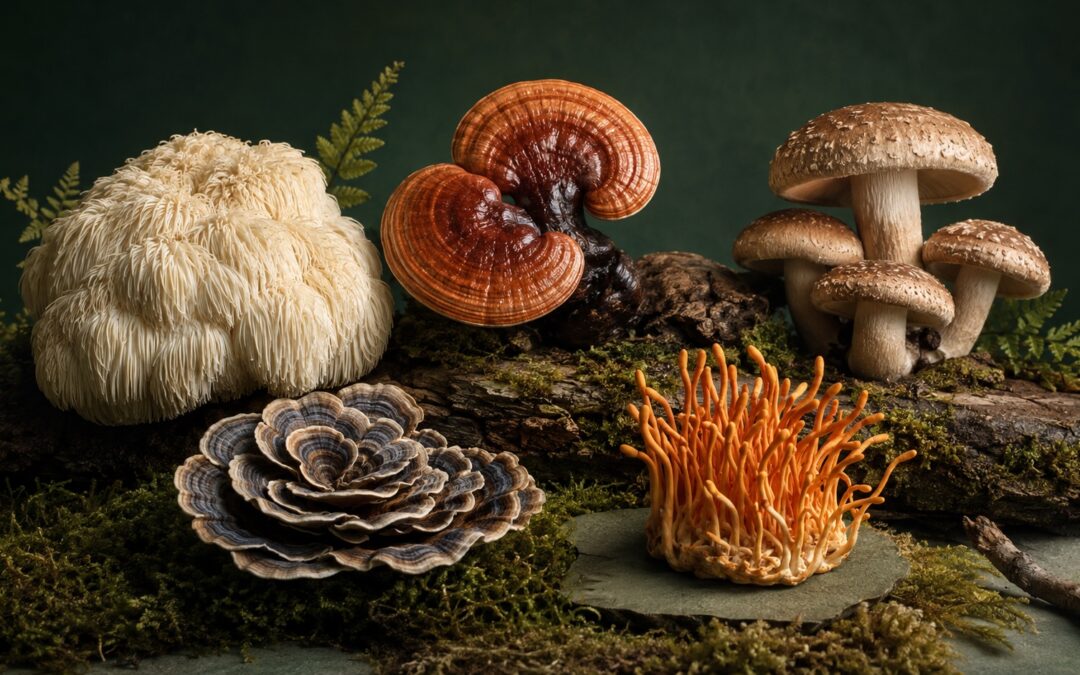
Functional mushrooms are having a moment, but the interesting story is not the trend. It is what human studies have actually measured, how much mushroom people took, and why the part of the mushroom matters.
Lion’s Mane, Reishi, Turkey Tail, Shiitake, and Cordyceps are not interchangeable. Each species has its own chemistry, traditional use, study doses, and reasons people keep coming back to it.
What makes a mushroom “functional”?
“Functional mushroom” is a practical category, not a single scientific definition. It describes mushrooms used for something beyond basic nutrition. The best conversations connect three things: the species, the preparation, and the result that was actually measured.
That last point matters. A study might measure a cognitive test, a fatigue rating, immune cell activity, or time to exhaustion on a bicycle. Those are very different outcomes. A strong article tells you which one changed and does not stretch it into a guarantee.
Why fruiting body deserves a place on the label
The fruiting body is the mushroom structure you can see. The mycelium is the network of fungal threads that grows through a substrate. Both are real parts of the organism, but they can carry different compounds and very different amounts of beta glucan, starch, and other constituents.
One useful comparison: Researchers measured ten Shiitake cultivars and found that the fruiting body generally contained more glucan than the corresponding mycelium. The results varied by cultivar and by cap or stem, which is exactly why “mushroom” alone is not enough information. Read the Shiitake composition study.
Fruiting body is not a magic word and mycelium is not automatically useless. The practical advantage is transparency. When the label names the mushroom part and the daily quantity, you can compare the product with the material used in published studies. Luminary’s single mushroom products use organic fruiting body extracts and state the amount per capsule.
What human studies reported
These are not promises about every supplement. They are concrete examples of what researchers gave people and what changed in those specific trials.
Attention and cognitive scores
A 28 day pilot in healthy younger adults found faster performance on one Stroop task after a single dose and a trend toward lower self reported stress after continued use. In adults over 50, a 12 week trial using 3.2 g of powdered fruiting body reported improvement on the Mini Mental State Examination, while two other cognitive tests did not significantly change.
Fatigue and sense of well being
In a placebo controlled trial involving people diagnosed with neurasthenia, a specific Reishi polysaccharide extract reduced fatigue ratings by 28.3 percent from baseline, compared with 20.1 percent for placebo. Self reported well being increased by 38.7 percent in the Reishi group and 29.7 percent with placebo. Just over half of the Reishi group was rated more than minimally improved, compared with about one quarter of the placebo group.
Immune cell activity
Fifty two healthy adults ate dried whole Shiitake each day. After four weeks, researchers measured 60 percent greater proliferation of one T cell type and a twofold increase in natural killer T cell proliferation. Salivary IgA increased and C reactive protein decreased. This was a food study using dried fruiting body, not an extract trial.
Exercise tolerance
A randomized study gave 28 active adults a mushroom blend led by Cordyceps militaris. One week did not produce significant differences from placebo. Ten people continued for three weeks, when maximal oxygen uptake increased by 10.9 percent and time to exhaustion increased by 8.2 percent from baseline. Because it was a blend and the extended group was small, the result is intriguing rather than definitive.
Immune recovery research
A small phase one study followed nine women after breast cancer radiotherapy. The Turkey Tail preparation was well tolerated at the tested doses, and researchers observed trends in lymphocyte counts and natural killer cell activity at higher doses. This was a safety and immune marker study in a medical setting, not evidence that a retail product treats cancer.
What those numbers do and do not tell you
The research is uneven. Some studies used whole dried fruiting body. Some used a standardized extract. One used a multi mushroom blend. The populations ranged from healthy young adults to people recovering from medical treatment. You cannot copy a dose from one paper and assume every capsule will reproduce the result.
You can still learn something valuable. Useful mushroom research tends to use gram level daily quantities, clear species identification, and repeated use over several weeks. It also reports specific outcomes instead of promising that one mushroom “does everything.”
A smarter way to choose
- Start with your question. Focus, fatigue, exercise tolerance, and immune markers belong to different research lanes.
- Match the species to the evidence. Lion’s Mane has a different human research story from Reishi, Shiitake, Turkey Tail, or Cordyceps.
- Read the daily amount. Ignore front label hype and calculate the full serving in grams.
- Identify the mushroom part. Look for fruiting body, mycelium, or a clearly stated combination.
- Ask for measured composition. Beta glucan testing is more useful than a vague total polysaccharide claim.
- Track one outcome. People often notice subtle changes. A consistent routine and one simple measure are more informative than chasing a dramatic feeling.
Choose the mushroom that matches the question you care about. Compare Luminary’s organic fruiting body extracts, daily amounts, and product details side by side.
The studies above examined specific materials, doses, populations, and outcomes. They do not guarantee an individual result or establish that every retail product is equivalent. To review authorized product information, recommended uses, and cautions, search the Health Canada Licensed Natural Health Products Database.