
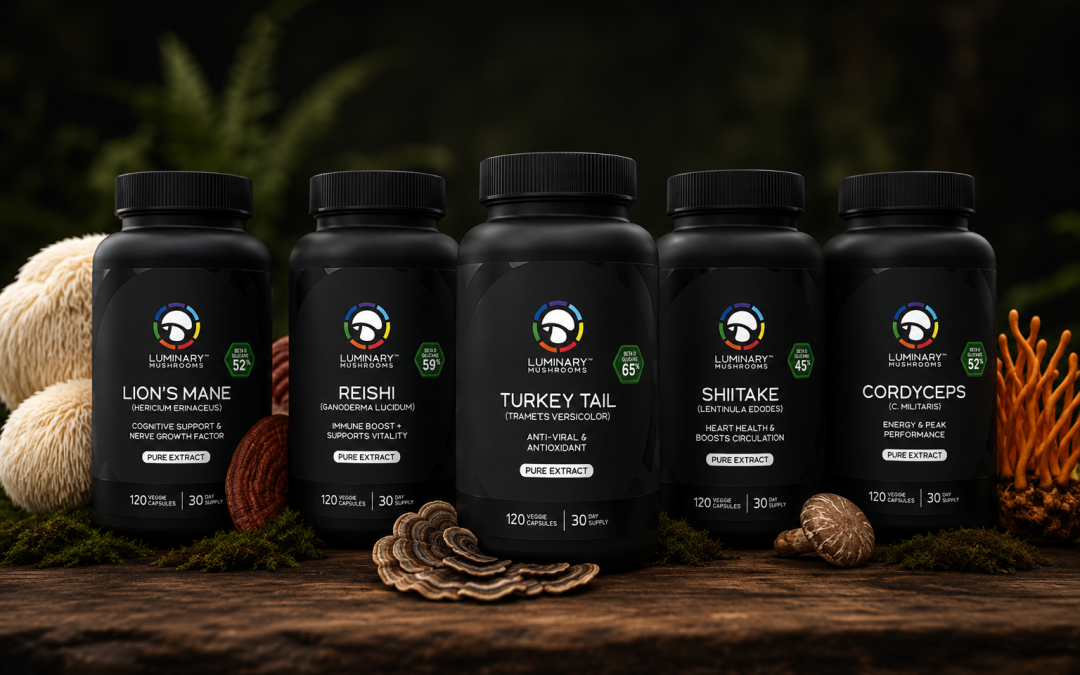
By Genio, founder of Luminary Mushrooms and Health Canada NPN license holder
Most mushroom supplement labels are designed to look informative without actually being informative. This article walks through the three most important things to check on any label, using Luminary’s own products as the worked example.
1. Fruiting Body vs. Mycelium on Grain
The first thing to locate on any mushroom supplement label is the source material. The label should tell you whether the product is made from the fruiting body (the actual mushroom cap and stem), the mycelium (the root-like vegetative structure), or mycelium that has been grown on a grain substrate and dried with the grain still present.
This distinction matters because mycelium-on-grain products are often powdered before the grain is separated from the fungal material. That grain contains starch, not mushroom compounds. Some independent lab analyses of popular mycelium-on-grain products have found that a substantial portion of the total weight is grain carbohydrate, not beta-glucans or other studied compounds.
Look for “fruiting body” or “fruiting body extract” in the ingredient list or supplement facts panel. If the label says “mycelium” or “full spectrum” without specifying the growing substrate, that is a gap in the disclosure worth noting.
Luminary uses fruiting body extracts across all five products in the line, including our Lion’s Mane capsules; link to Lion’s Mane product page
2. Beta-Glucan Percentage vs. Total Polysaccharides
This is the most commonly misrepresented number in the functional mushroom category.
Polysaccharides are a broad category of complex carbohydrates. Beta-glucans are a specific subset of polysaccharides, and they are what researchers have focused on in clinical studies of medicinal mushrooms. Starches are also polysaccharides, and they carry no relevant function in this context.
A label that says “containing 40% polysaccharides” is not saying the same thing as “containing 40% beta-glucans.” In a mycelium-on-grain product, a significant portion of those polysaccharides can be starch from the grain substrate. The polysaccharide number looks strong; the beta-glucan number tells you what you are actually getting.
Look for a stated beta-glucan percentage specifically. If the label only lists polysaccharides and does not break out beta-glucans, that omission is itself informative. Ask the brand for third-party lab results that show the breakdown.
Luminary’s Lion’s Mane capsules are standardized to a minimum beta-glucan content from fruiting body extract; link to Lion’s Mane product label details
3. What an NPN Actually Means
In Canada, any natural health product sold with a health claim on the label is required to carry a Natural Product Number (NPN) issued by Health Canada. The number is eight digits and appears on the label formatted as “NPN XXXXXXXX.”
Getting an NPN requires submitting a product dossier to Health Canada that includes evidence supporting the claimed use, documentation confirming that the manufacturing facility meets Good Manufacturing Practices (GMP), and a complete formulation disclosure. Health Canada reviews the submission and can reject it or require revisions before issuing the number.
Once issued, the NPN is tied to the specific formulation. A company cannot change the ingredients, the dose, or the label claims and continue using the same number. It cannot transfer the NPN to a different product.
You can verify any NPN by searching Health Canada’s Licensed Natural Health Products Database (LNHPD) at canada.ca. Enter the number and you will see the approved product name, the licence holder, the approved claims, and whether the licence is currently active.
Luminary holds an NPN for each product in the line:
– Lion’s Mane: NPN 80126702 – Reishi: NPN 80126706 – Turkey Tail: NPN 80126705 – Shiitake: NPN 80126704 – Cordyceps: NPN 80126703
All five are active and verifiable in the LNHPD. I am the licence holder personally, which means I am the party accountable to Health Canada for what appears on these labels. That accountability is not transferable to a contract manufacturer or a third-party brand.
Why These Three Questions Matter
The supplement market in Canada is better regulated than in many countries, but the NPN system only covers products that make a health claim on the label. A product sold without claims can still reach Canadian shelves without an NPN. In that environment, the three questions above, fruiting body or mycelium on grain, beta-glucan percentage not just total polysaccharides, and does an NPN exist and verify in the LNHPD, filter out most of the lowest-quality products currently on the market.
If you want to see how these numbers appear on a real label reviewed by a federal regulator, the full formulation details for Luminary’s Lion’s Mane capsules (NPN 80126702) are on the product page at luminarymushrooms.com.