
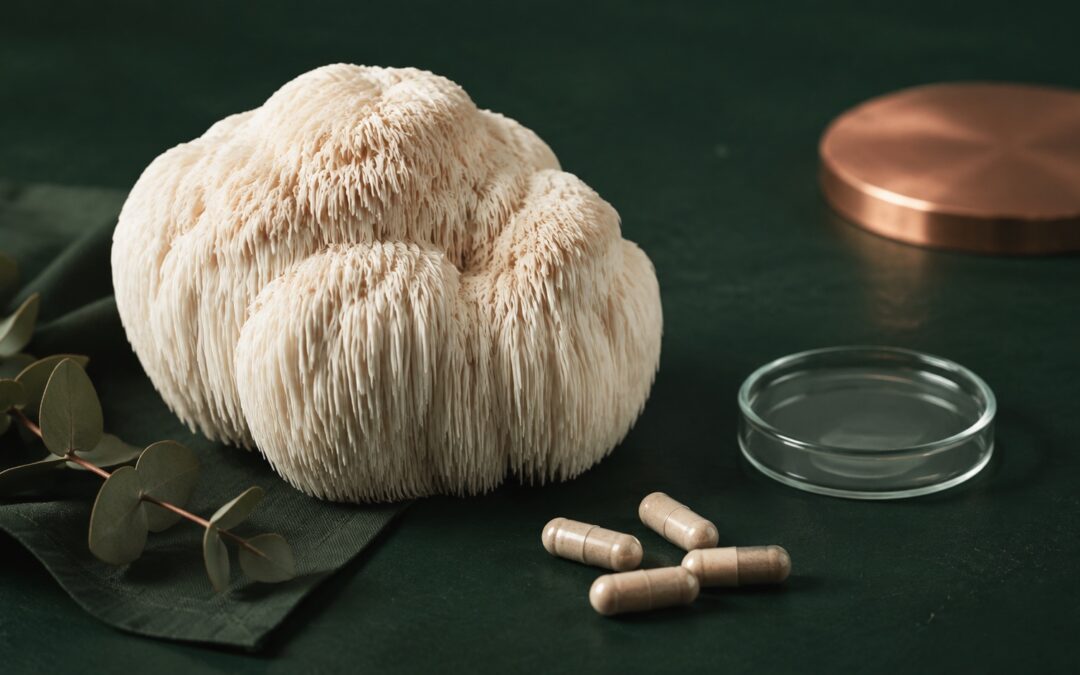
Human Lion’s Mane studies have used 1.8 g, 3 g, and 3.2 g per day. Here is what participants experienced, why fruiting body matters, and where Luminary’s 2 g daily routine fits.
The useful question is not “What is the perfect dose?” It is “What amount has actually been studied, in what form, for how long, and with what result?”
Lion’s Mane dosage advice gets vague fast. Some products hide the amount inside a blend. Others use a small extract number without explaining the dry mushroom equivalent. A meaningful comparison needs three facts: the daily amount, the part of the mushroom, and the preparation used.
The Luminary routine
Four capsules provide 2,000 mg of organic Lion’s Mane fruiting body extract at a 1 to 1 ratio. The routine is two capsules in the morning and two in the evening.
What did human studies actually use?
The human evidence is still early, but the dose range is not a mystery. Several controlled trials land close to the amount in a serious daily mushroom routine.
A 2023 double blind pilot followed 41 healthy adults for 28 days. After a single dose, the Lion’s Mane group completed a Stroop task faster. After 28 days, participants also reported a trend toward lower subjective stress, although it narrowly missed the usual threshold for statistical significance.
In a 16 week placebo controlled trial, 30 adults with mild cognitive impairment took powdered Lion’s Mane or placebo. Cognitive scale scores were higher in the Lion’s Mane group at weeks 8, 12, and 16. Scores declined four weeks after intake stopped.
A 12 week randomized trial in adults over 50 used powdered Lion’s Mane fruiting body. The Lion’s Mane group improved on the Mini Mental State Examination. The other two cognitive tests did not show a significant difference, an important reminder that one positive measure is not the same as a universal effect.
What the numbers mean: Luminary’s 2 g daily amount sits inside the same general range explored in human trials. That does not make the products interchangeable and it does not guarantee the same response. It does make the dose concrete, transparent, and easy to compare.
Why fruiting body belongs in the conversation
The fruiting body is the part most people recognize as the mushroom. It contains beta glucans and, in Lion’s Mane, compounds known as hericenones. Mycelium contains its own chemistry, including erinacines. Both parts are scientifically interesting, but they are not chemically identical and should not be treated as interchangeable on a label.
Fruiting body has another practical advantage: it is the form used in several of the best known human Lion’s Mane studies. The 3.2 g study above specifically tested powdered fruiting body. A separate acute trial tested a standardized fruiting body extract in healthy younger adults. That small study did not find broad improvements across cognition or mood, which shows why preparation, population, and duration matter as much as the headline dose. Review the acute fruiting body study.
Research on other edible mushrooms also shows why the source material deserves attention. In a laboratory comparison of ten Shiitake cultivars, fruiting body samples generally contained more glucan than the corresponding mycelium. The exact numbers varied by cultivar and mushroom part, so the sensible takeaway is not that every fruiting body is automatically potent. The takeaway is that source and measured composition should be visible, not hidden. See the glucan comparison.
What people noticed, and when
Results were not instant or identical. In the 16 week cognitive trial, the separation from placebo appeared at week 8 and continued through weeks 12 and 16. In the 28 day young adult pilot, the clearest acute result was faster performance on one attention task, while the longer term self reported stress result was promising but not conclusive.
That pattern is more useful than a promise. Lion’s Mane is not a stimulant switch that flips on for everyone. The studies point to a routine measured in weeks, not a dramatic feeling after one capsule.
How to compare Lion’s Mane products
- Find the total daily amount. Milligrams per capsule can look impressive until you calculate the full serving.
- Check the mushroom part. The label should clearly say fruiting body, mycelium, or a combination.
- Understand the ratio. A concentrated extract and a whole powder are different preparations. Compare dry mushroom equivalent where it is provided.
- Look for measured beta glucans. “Polysaccharides” can include starch. A specific beta glucan result is more informative.
- Give your routine a fair test. Track focus, recall, stress, or another single outcome consistently instead of relying on a vague impression.
A transparent dose makes a better experiment. Luminary Lion’s Mane gives you 2 g per day from organic fruiting body, with a routine simple enough to follow consistently.
Human studies referenced here tested specific preparations and populations. Individual responses vary. For the authorized product information, recommended use, and cautions for Luminary Lion’s Mane, review NPN 80126702 in Health Canada’s database.